
How Arrest Warrants Work in Seminole County
An arrest warrant lets police take a person into custody on a suspected crime. It rests on probable cause. In practice, the sworn facts must be strong enough for a judicial officer to authorize arrest. A peace officer brings the sworn information. The judge weighs it. Seminole County Magistrate Court describes its own duties as issuing arrest and search warrants, holding first appearances, setting bond, and running preliminary hearings. Georgia expects detail too. Discussing O.C.G.A. § 17-4-41, the Georgia sheriff handbook says a warrant or its affidavit should state the offense and county plus time, date, place, victim, and offense description as nearly as practicable. Theft allegations call for added property and owner facts. A 2026 state change concerns notice and warrant-application hearings. Confirm current application practice with the issuing court in Seminole County.
Seminole County Magistrate Warrant Role
For a Seminole County arrest warrant, Seminole County Magistrate Court is the first office to try. It sits at 200 S Knox Avenue in Donalsonville. The phone number is (229) 524-5256. This court issues arrest and search warrants, holds first appearances, considers bond, and runs preliminary hearings. That puts the Magistrate Judge at both ends of many local warrants, from issuance through the first court stage after service. The court does not replace the sheriff, though. The judge issues the paper; law enforcement serves it and manages custody. Magistrate Court does not keep every criminal file, either. A felony moves to Superior Court under its general jurisdiction, with records routed through Clerk Earlene Bramlett. Knowing the case stage saves a call to the wrong office. The official court page lists the county's warrant functions.
View the Seminole County Magistrate Court source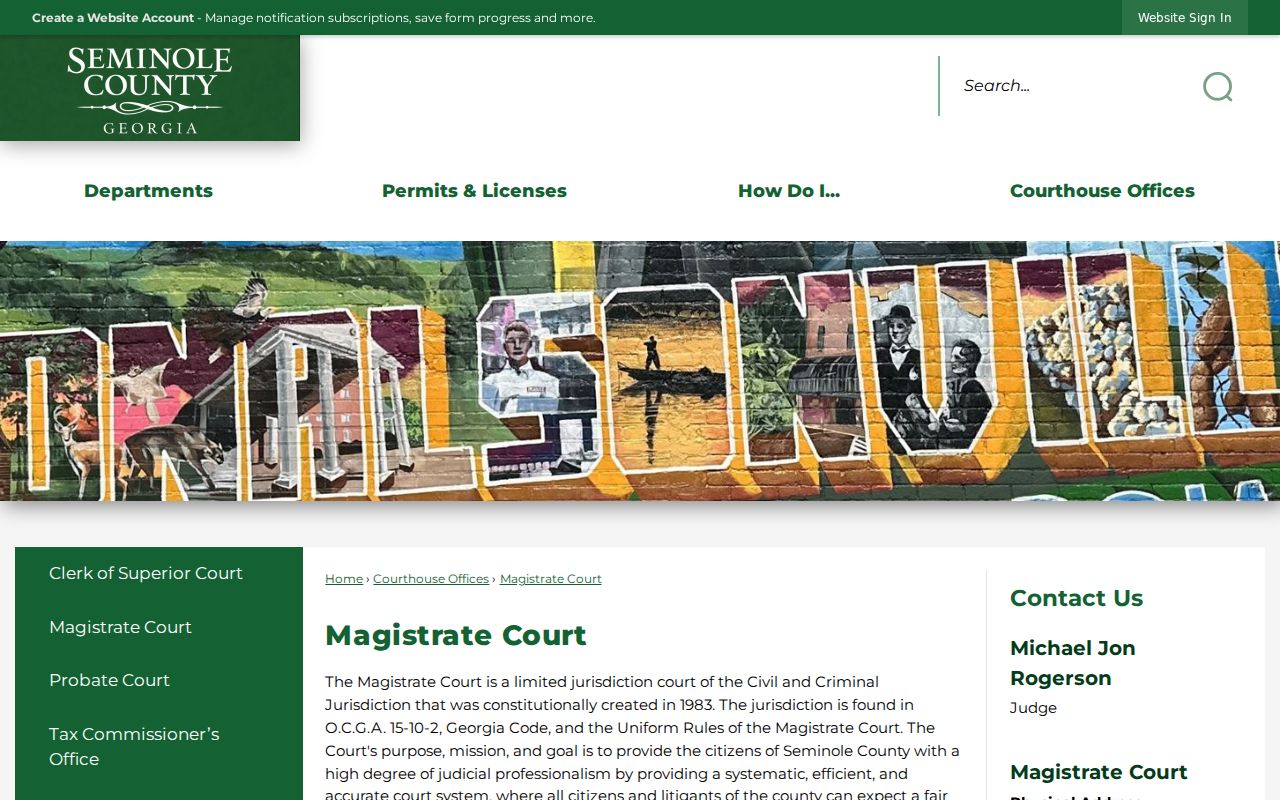
The official Magistrate Court page lays out the issuance and first-appearance route a Seminole County arrest warrant follows.
Arrest Warrants: What They Contain
Seminole County publishes no layout for unserved warrants. No local warrant-number format appears either. The fields below pair Georgia's required warrant facts with the post-booking fields on the live jail roster, which shows bookings rather than a complete active-warrant list.
| Warrant identifier | May identify the process, but Seminole County publishes no official format rule. |
|---|---|
| Offense facts | Offense, county, time, date, place, and description as nearly as practicable. |
| Judicial source | The issuing judge or magistrate and court connected to the process. |
| Charge data | After booking, the roster may show count, Georgia Code section, description, and felony or misdemeanor marker. |
| Agency and date | The arresting agency and arrest date can appear after service. |
| Bond and status | Bond and custody fields concern release status, not guilt or final case disposition. |
The Seminole County Clerk profile lists county code 125. That code is no warrant-number pattern, so treat no private roster entry as a format guide.
Seminole County Felony Record Route
Seminole County felonies go to Superior Court. It belongs to the Pataula Judicial Circuit. The Georgia Superior Court Clerks' Cooperative Authority profile lists Earlene Bramlett as Clerk. Her office sits at 200 S Knox Avenue, reachable at (229) 524-2525 weekdays from 8 a.m. to 5 p.m. She manages Superior, Juvenile, and Magistrate records. Probate and Donalsonville Municipal Court keep separate routes. A clerk file can identify the case, charge, docket activity, or issuing court where disclosure allows. That is not a warrant-status check. The sheriff answers whether a warrant is still open for service. When status matters, call both the clerk and the warrant desk in Seminole County. Georgia's e-access page lists Seminole Superior Court among provider-based systems, warning that an outside provider and account may be required. The clerk profile displays the office and its record scope.
View the official Seminole clerk profile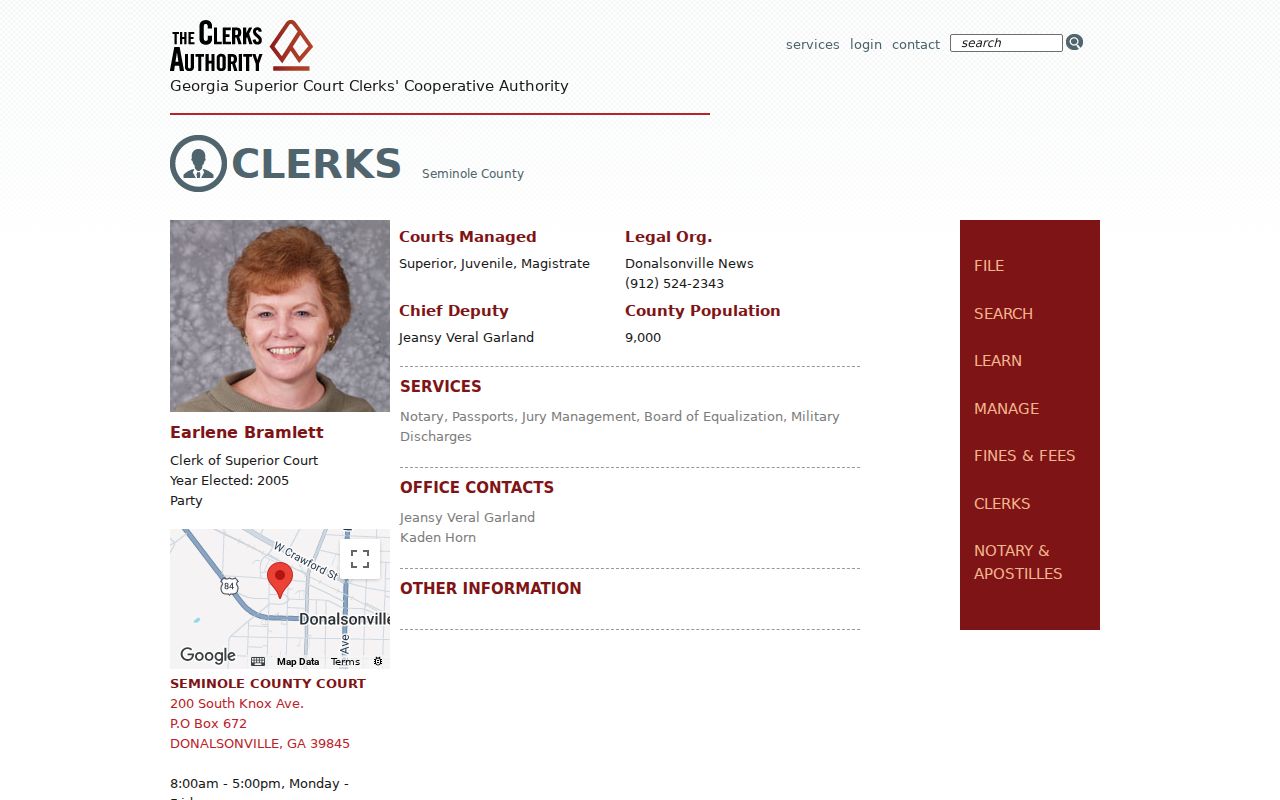
The profile helps distinguish court-file access from sheriff service and custody records.
How Warrants Get Served in Seminole County
The Seminole County Sheriff runs county law enforcement and the jail. Donalsonville Police covers the city itself. The jail houses both sheriff and city police inmates. A warrant may be served through direct police action or another lawful contact. Seminole County has no constable or marshal office. For status, call the Sheriff at (229) 524-5115 and ask for warrant extension 7107. The office sits at 208 Court Street. It states it is open around the clock. Ask whether staff release warrant information by phone or require government identification in person. Georgia.gov warns that an in-person inquiry can mean immediate custody if a warrant exists. A records request is another channel for a document. It is no safe substitute for arranging a response to an active Seminole County warrant.
Sworn facts → judicial review → warrant issuance → sheriff or police service → booking → first appearance and bond → later court proceedings.
Seminole County High-Risk Warrant Support
The sheriff's K-9 Unit page reports five canine and deputy teams working across Seminole County. Their duties include tracking suspects. They also recover evidence and help serve high-risk warrants. That is service support, not a public warrant search or fugitive roster.
View the sheriff's K-9 Unit source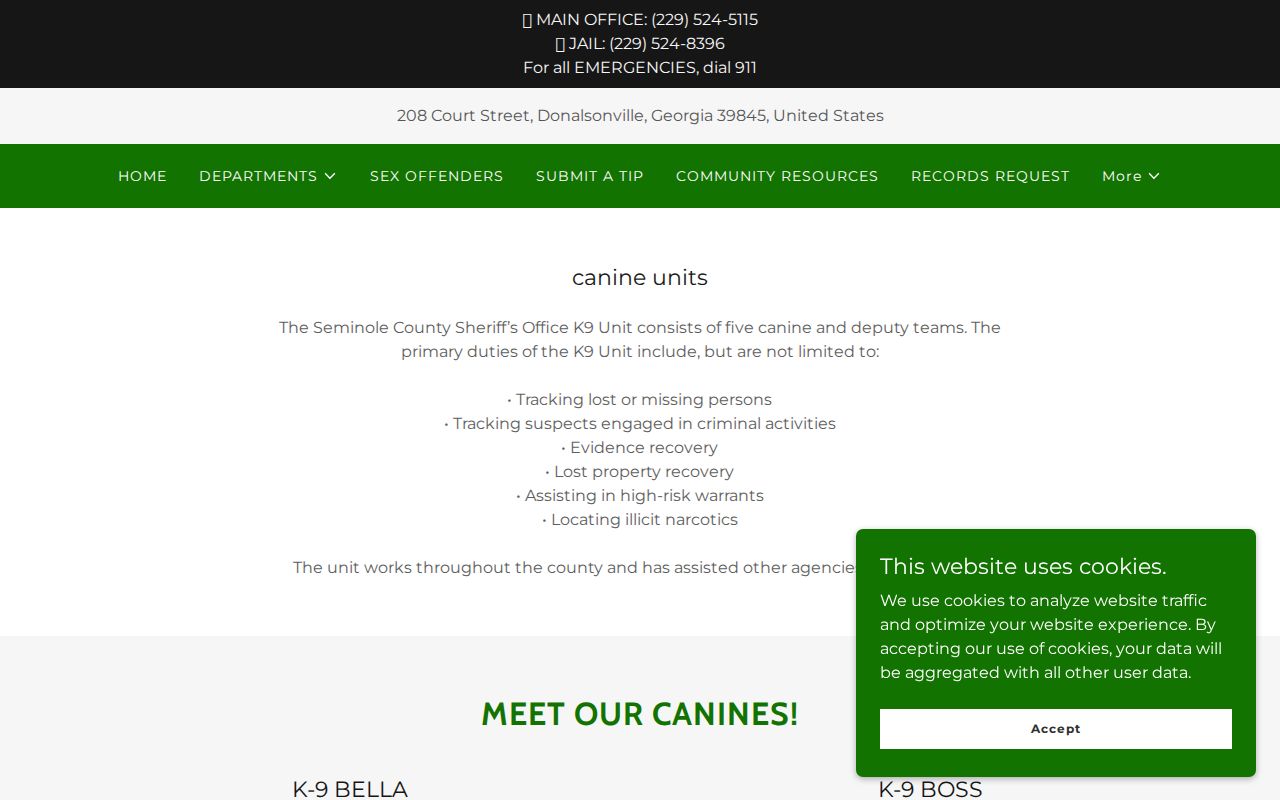
High-risk warrant support exists here. Seminole County confirms the help but shares no names, cases, or active warrant list. There is no public fugitive task-force page, roundup schedule, warrant count, or most-wanted roster either. The U.S. Marshals Service does place Seminole County in the Middle District of Georgia, and that federal work runs on its own track. It never substitutes for asking the local issuing court directly.
Arrest Warrants, Summonses, and Bench Warrants
Each order demands a different response. An arrest warrant orders custody on probable cause. A summons just tells a person to come to court, with no arrest ordered up front. Skip a court obligation you already had, and a bench warrant can follow. One paper is not the next, so learn which one Seminole County actually issued before you act.
| Feature | Arrest Warrant | Summons | Bench Warrant |
|---|---|---|---|
| Core command | Take the named person into custody | Appear as directed | Arrest for a missed duty |
| Basis | Probable cause of an offense | Notice to answer a case | Failure to appear or comply |
| First response | Attorney, status check, surrender plan | Attend by the stated date | Contact the issuing court about recall |
| Typical court focus | First appearance and bond | Scheduled hearing | Reset, bond, recall, or quash |
Not sure which order is in play? Ask court staff to read you the exact label and case number. The Seminole County bench warrant route covers missed-date orders in more depth.
First Appearance After Seminole County Service
Booking comes first, then court review. Per the Seminole County jail page, anyone arrested on a warrant goes before the Magistrate Judge for a bond hearing. Call the jail at (229) 524-8396 for scheduling questions. No local source promises a fixed 24-hour or 48-hour timeline, so confirm current timing with the jail or court. Once set, bond can be cash, approved property, or surety. A property bond in Seminole County needs approval from the Sheriff or Chief Deputy. Property sitting in another Georgia county needs that county sheriff's sign-off instead. State law lets an authorized bonding agency charge up to 15 percent of the bond. The jail also lists a nonrefundable $20 cash-bond fee, except in Municipal Court cases. Release comes with conditions attached. Bond does not dismiss the charge.
- First appearance
- The first judicial hearing, where the warrant case may receive a bond decision.
- Surety bond
- A bond posted through an authorized bonding agency for a fee.
- Property bond
- Approved real-property security supporting release and later appearance.
Handling an Arrest Warrant in Your Name
Move before a traffic stop forces the issue. Seminole County publishes no surrender form, walk-in window, motion form, or filing fee. A lawyer can call the issuing court, confirm the warrant type, ask about voluntary surrender or an arranged walk-through, and go over bond with you. Whether a motion to recall or quash fits is a call only the court can make.
- Prepare the full name, date of birth, county, and known case or charge details.
- Call the sheriff's warrant extension and the likely issuing court for current status.
- Ask counsel about voluntary surrender, first appearance, bond, and any court motion.
- Confirm where and when to report; do not rely on an online blank result.
- Keep booking, bond, release, and court papers, then verify later status with both offices.
Important: Speak with a lawyer before appearing in person because a Seminole County arrest warrant inquiry can lead to immediate custody.
Want a warrant document itself? The sheriff takes records requests through the official form. Pending-investigation, sealed, juvenile, or court-restricted material may be withheld, and you can ask for the legal authority behind any denial.
Restricted Seminole County Arrest Warrant Records
Public access stops at a line. Georgia keeps juvenile records confidential, and no comprehensive public statewide repository holds them. A sealed warrant or indictment can stay hidden by law or court order. Active-investigation records may be withheld too, under a Georgia Open Records Act exemption. A blank court screen, sheriff page, or records response still does not prove that no warrant exists. The jail roster starts only after booking. It may list the arresting agency, arrest date, court, warrant number, Georgia Code section, charge description, felony or misdemeanor marker, bond, and custody status. It cannot clear someone never booked. Georgia Felon Search is not a warrant search either. That paid criminal-history product leaves out misdemeanor, juvenile, sealed, and expunged information. Federal warrants add yet another layer. PACER may show public docket entries for an open, accessible federal case, but it is not a Seminole County warrant database. Take federal process to the federal court or the U.S. Marshals. For any Seminole County order, the local issuing court is the one to ask.